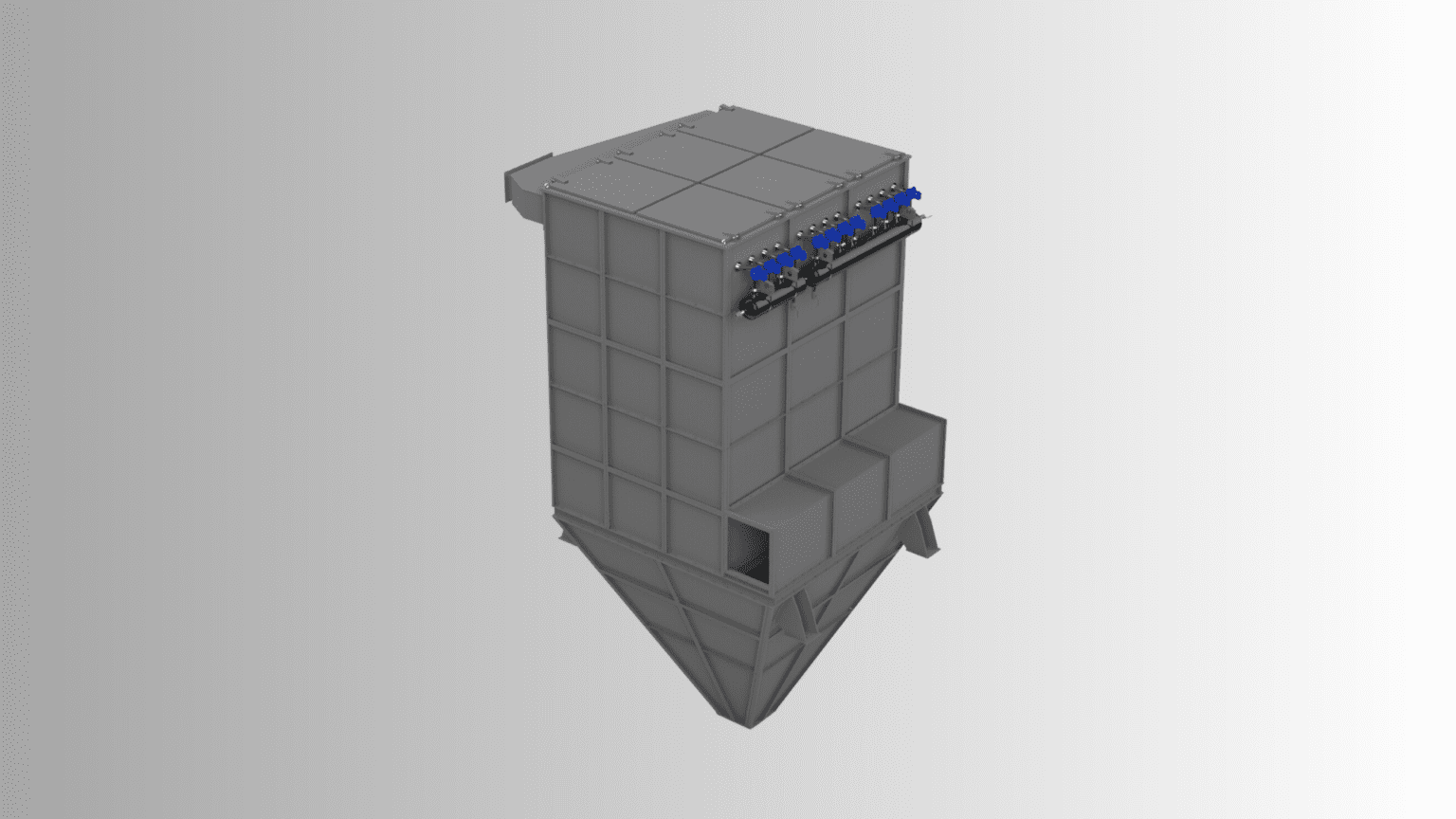


Dust control in industrial facilities is critically important not only for meeting
environmental standards but also for enhancing production efficiency and
prolonging equipment life. In sectors such as cement, lime, food, mining, and
chemicals, the formation of high volumes of particulate matter is inevitable.
Various systems are used to effectively filter these particles, with cyclones and jet
pulse filters being among the most common. While both systems are used for dust
removal, they differ significantly in their working principles, efficiency levels, and
areas of application.
Cyclone Filters: Simplicity and Mechanical Durability
Cyclones are among the simplest dust separation systems and operate entirely on
mechanical principles. When dusty air enters the cyclone, centrifugal force causes
larger particles to be flung toward the walls and then fall into a dust collection
chamber. This system is particularly effective for separating coarse dust.
One of the main advantages of cyclones is their low maintenance requirement due
to the absence of moving parts. Additionally, their resistance to high temperatures
makes them ideal for heavy industries such as cement and metallurgy. However,
their efficiency drops when it comes to capturing small and light dust particles.
Therefore, cyclones are often used as pre-separators, followed by more precise
filtration systems.
Jet Pulse Filters: High Efficiency and Fine Particle Control
Jet pulse filters are especially effective in capturing fine and sub-micron dust
particles. They mainly consist of bag filters; as dusty air passes through these bags,
the particles are trapped on the filter surface. The filters are cleaned at regular
intervals using high-pressure air pulses, allowing for continuous operation.
Jet pulse systems offer over 99% filtration efficiency, making them highly
advantageous for meeting environmental regulations. Thanks to their precision
filtering capability, they are also preferred for product recovery. However, they do
require maintenance such as periodic cleaning and replacement of the filter bags.
Although energy consumption is higher than cyclones, the accuracy they provide
often offsets this disadvantage.
When Should Each System Be Preferred?
The primary criterion in choosing between cyclones and jet pulse filters is the
particle size of the dust to be captured and the nature of the process. If the process
involves high temperatures and primarily coarse particles, cyclones are ideal as
pre-filters. On the other hand, if the goal is to prevent fine dust from escaping into
the environment or to minimize product loss, jet pulse filters should be preferred.
In many industries, these two systems are used in combination. Coarse separation
is first achieved with a cyclone, followed by precise cleaning with a jet pulse filter.
Such integrated solutions enhance system efficiency and extend filter lifespan.
Cyclones and jet pulse filters are two complementary technologies that meet
different needs in dust collection systems. While cyclones stand out with their
mechanical simplicity and durability, jet pulse filters deliver superior performance
through their high-precision filtering capacity. When deciding which system to use,
the nature of the process, the physical characteristics of the dust, environmental
requirements, and operating budget sh